




So, the latest Budget included a series of announcements that will impact car drivers, and yes, it had some news for electric car owners. From April 2028, it’s proposed that EV drivers will pay a new road charge: 3p per mile for battery electric cars, and 1.5p per mile for plug-in hybrids. And, as anticipated, it’ll go up a bit each year with inflation.
More positive news for vans, buses, and HGVs, who are off the hook and won’t be paying this mileage fee.
Of course, the familiar chorus of “how will this affect EV sales?” has started. But let’s be honest, a mileage charge was always on the cards. Why? Because tax revenue from petrol and diesel is dwindling as more of us switch to electric.
Why the Pay-Per-Mile Makes Sense
Here’s the math. Back in 2015, the UK raked in about £27.4 billion from fuel duty. Fast forward to the last financial year, and that figure dropped to around £24.6 billion, the lowest since 2006/07 (excluding the pandemic years, obviously). Fuel duty revenue is on a downward trajectory, and that gap needs to be plugged somewhere.
Petrol and Diesel: What’s Changing
Right now, petrol and diesel drivers pay 52.95p per litre in fuel duty (frozen since 2022) plus 20% VAT on top. But starting next September, fuel duty will slowly climb back to 57.95p per litre by March 2027. So even before EVs start paying per mile, petrol and diesel drivers are already facing higher costs.
Fuel Duty: Already a Kind of “Pay-Per-Mile”
Here’s the thing, fuel duty already behaves as a distance-based tax. The more miles you drive, the more fuel you burn, and the more tax you pay.
Sure, MPG and engine efficiency make it a little more complex than a flat per-mile fee, but it works out similarly. And don’t forget there are still lower VAT costs with EVs. When charging an EV at home, it only costs 5% in VAT, compared with 20% VAT payable on petrol and diesel. While the same 20% VAT rate also applies to public EV charging, the majority of EV owners charge at home, 84% to be exact, so most EV miles already come with a tax advantage.
The Bottom Line
Even with the new 3p per mile charge, EVs still look pretty good compared with petrol or diesel. The University of Strathclyde’s Fraser of Allander Institute crunched the numbers for the average 2023 mileage (7,100 miles/year):
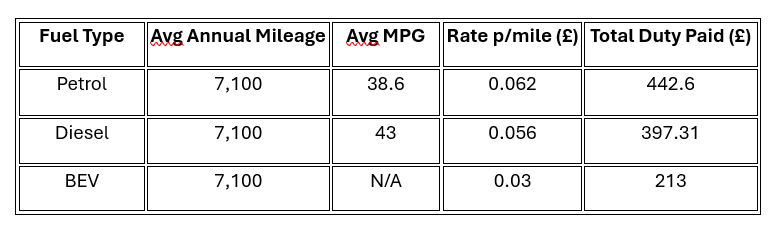
Even without considering the VAT perk, for home charging, EVs will pay about half the tax per mile of petrol or diesel cars when the pay per mile tax comes into play.
Another Budget win for EVs is a rise in the “luxury car tax” threshold.
Officially known as the Vehicle Excise Duty (VED) Expensive Car Supplement (ECS). It is an extra £425 annual charge that applies for five years (from the second to the sixth year of the car's life). The threshold for zero-emission cars is rising to £50,000, while for petrol and diesel cars it stays at £40,000.
These changes are on top of other driving costs that favour EVs typically, like lower maintenance costs, and generally cheaper road tax. As a result, EVs are still looking pretty smart on running costs.
Statistical information referenced was correct at time of publication [27/11/25 - https://fraserofallander.org/budget-measures-you-may-have-missed/].



.png)